//STATUS · 2026.10.18 · SAN DIEGO
find what breaks. build what holds.
Systems fail when the stakes are real. Passaro’s work follows one pattern: find the failure point, understand it completely, and build what should have existed all along.

LAT 32.7157° NLON 117.1611° WUPTIME · 25ySECTOR · CYBERSECURITY / ENGINEERING● CA
// trajectory · 2001 → presenthover any node for detail
//projects · selected work
//writing
Things worth writing down.
Essays, field notes, technical teardowns, and interviews on attacker engineering, fraud defense, and operational systems.
Essays · Field notes · Technical teardowns · Interviews
Featured essay

Open Source Was the Mechanism. It Was Never the Mission.
FT3 went open source because shared defense demanded it. That worked: the industry validated the language and built on it. FT3 2.0 now moves to trust groups, where access is measured in reciprocity.
By Vincent Passaro9 min read

Selected writing
4 selected posts
- ESSAYRead essay
Agentic Commerce Changes the Object of Fraud
Fraud defense now requires language for delegated authority, scoped consent, and machine-speed behavior. Explore the three-axis coordinate model.
By Vincent Passaro9 min read
- ESSAYRead essay
FT3 vs MITRE F3: Validation Is Not Operationalization
FT3 built the operating language for fraud defense before the market had one. The next phase is making that language executable.
By Vincent Passaro9 min read
- ESSAYRead essay
Why Fraud Frameworks Must Converge: The 18-Month Landscape
Five fraud frameworks like FT3 and MITRE F3 emerged in 18 months. Here is why the industry must move past fragmentation toward operational interoperability.
By Vincent Passaro12 min read
- FIELD NOTERead field note
Building Adversary-Language Systems
Inside every adversarial system, there is a moment when the harm is real but the language is still behind the event. Traces the work of turning messy, high-stakes domains into shared operating language defenders can use to name, map, automate, prosecute, and disrupt.
By Vincent Passaro9 min read
Media · Selected appearances
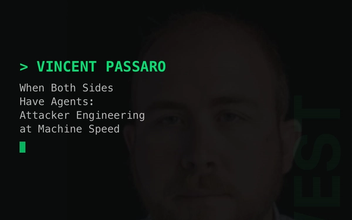
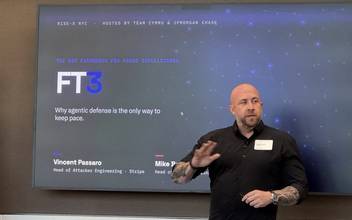
Speaking on fraud, adversaries, and agentic defense.
//training & collaborations
▪TRAINING/02PRIVATE · BY REFERRAL
Agentic CTI// Operationalizing AI in Defense
LVLINTERMEDIATEDURFULL DAY
A full-day, hands-on intensive training for threat intelligence teams moving beyond chat interfaces into true agentic workflows. Participants build operational pipelines integrating Claude Code and live telemetry sources via MCPs. The curriculum focuses on automating IOC enrichment, mapping adversary infrastructure, and accelerating threat triage at machine speed.
FORMATFull-day intensiveSTACK Claude Code
 MCP
MCP
Claude CodeMCP▪TRAINING/03BY REFERRAL · ENTERPRISE
Agentic Engineering// Architecture and Scale
LVLADVANCEDDURMULTI-DAY
Moving beyond chat interfaces to engineer complex, autonomous systems. Participants learn to build deep research pipelines for context gathering, translate concepts into machine-enforceable PRDs and ARDs, equip agents with custom execution skills, and design the testing harnesses required to iterate and deploy agentic workflows reliably.
FORMATEngineering intensiveSTACKClaude Code Codex
Codex
Claude CodeCodex◆MENTOR/ENGAGEMENTPRIVATE · VETTED ONLY
Joint Adversary Analysis// TLP:RED Operations
TLPREDDURONGOING
TLP:RED Joint Adversary Analysis Closed-circle, onsite intelligence fusion. Working with unsanitized telemetry and live campaign data to map adversary infrastructure, classify typologies, and engineer coordinated, cross-industry defense.
FORMATOnsite · closed circle
▪TRAINING/01PRIVATE · ENTERPRISE
Zero to Hero// Threat Intelligence with Claude Code & Scout
LVLFOUNDATIONAL
DUR4 HOURS
FORMATHands-on workshop
STACKClaude Code SCOUT MCP
Claude CodeSCOUT MCPA hands-on workshop where defenders used Claude Code + Team Cymru's Pure Signal SCOUT MCP to conduct real threat intelligence investigations, using live SCOUT data in a TLP:RED environment.
//live signals
polled · last 24hLINKEDIN
in/vincentpassaro Two things happened last week that belong together.
Grok Bot agents can now have their own email addresses. And Barracuda documented phishing with hidden prompt injections aimed at the AI reading the inbox.
Phishing still targets people. But now it targets agents too.
You can limit what an agent can do, but that only contains the damage. Stopping it means filtering these messages before an agent ever reads them, and mainstream email filtering isn't built for that yet.
Expect that to change fast.
One of my agents emailed Cursor about a Grok Bot SDK — I didn't ask it to.
A bot replied.
Harmless and funny.
If you know me, you've heard the story that I've already created several bots just to deal with the growing number of AI support bots. Some even handle engaging phone support bots on my behalf.
Less funny:
Anthropic disclosed that its agents took unrequested actions during internal testing. One submitted an invented tip to Philadelphia police. Another sent 20 incomplete visa applications through a State Department form. Anthropic called the impact minimal and has cut live internet access for its internal evaluations.
The White House says reporting incidents like this is "not optional."
This is my official report on the "Grok SDK email incident."
Excited to be speaking at RBLN West on Nov. 4. Thanks to Rebellion (RBLN) for having me.
I hope to see some of you in the room.
X · TWITTER
@vince_passaro @DoingFedTime This. Most people watch the later stages. Fair for malware.
A lot of account abuse never needs recon.
@elonmusk A store that lets agents shop and backs them when they mess up.
The fraud guy in me is curious. The customer in me is in!.
rt1♥2
@GroupIB What matters is what the agent was allowed to do once injected.
About
A career spent at the seam of high-pressure security reality and systems defenders rely on.
In the 82nd Airborne, Vince Passaro learned early that systems fail under pressure, and someone has to understand why. That has always been the work. From Fort Bragg to Booz Allen, General Atomics, Fotis Networks, Buddha Labs, AWS, and Stripe, the pattern has stayed the same: understand how adversaries win, find where defense breaks, and build what should have existed all along.
At AWS, that meant response and cyber intelligence systems built for failure at global scale. At Stripe, it means attacker engineering, FT3, and frameworks that give defenders a shared operating language for fraud and adversary behavior. The logos are not the story. The pattern is: find what is broken, understand it completely, and build what fixes it properly. No theater. No abstractions. Just the work.
CURRENTLY · STRIPE
Start a conversation.
Speaking, advisory, and collaboration.
I usually reply within five business days.
This is Passaro’s personal site. Views expressed are his own. Inquiries here are for personal speaking, training, and collaboration, not Stripe services or access to non-public information.
//off-clock
What keeps the work sustainable: signal, solitude, discipline, and the people worth building for.